
John Deere suffers. The land heals.
This is, of course, overstating the facts, but indeed it is, at least for the hopeful few, a possible harbinger of a small respite that is in order for the once sea of prairie that is not corn that covers the landscape of Iowa. Indeed, the news has been bleak for John Deere (especially their employees) over the last few years, with things continuing to heat up.
TDLR:
As Deere suffers and the agriculture economy as a whole, across Iowa, contracts, it is possible the land may get a small, brief, respite from the continual environmental flogging it recieves. How so? The weak farm economy might spur an increase in CRP, row crop acres dropping generally, less chemicals and fertilizers being dumped (opps, I mean sprayed).

I mean, take what I say, and armchair wanna-be economist and general news commentator, but Deere (the bellwether of Agriculture in the Midwest and across the world for that matter), if facing stiff headwinds in the agriculture economy due to tariffs, weak demand, and lackluster grain prices.
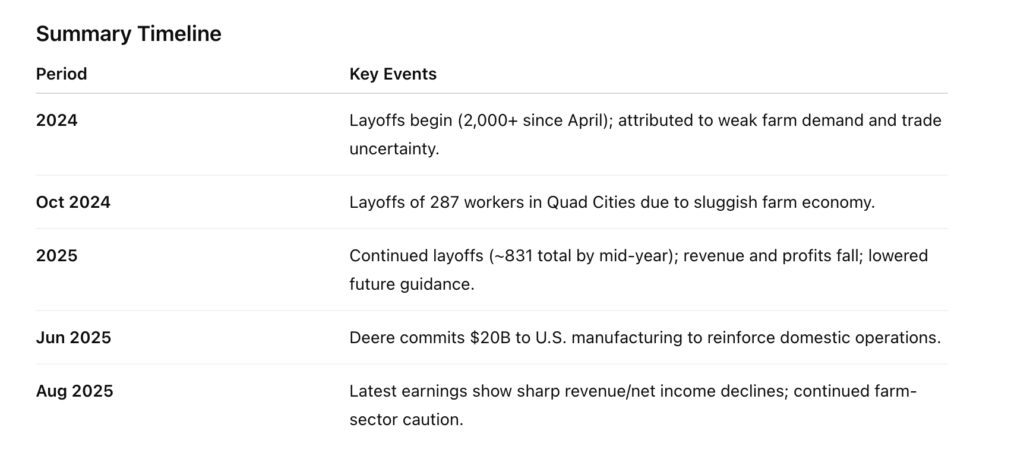
If ChatGPT is to be trusted, this is what has happened recently.
The Land Heals
So what is this newfound hope I have that the misery of the farmers that make up this great state of black loam and oak savannahs might be a boon for the average non-farming resident who happens not to enjoy laced drinking water? Well, it’s a hope based on someone who grew up in a cornfield and worked in agriculture for many years, becoming jaded but learning enough to understand basic economics and the filthy lucre that seems to drive the rows of corn that have become the bane of my existence.
What have we learned this year?
Most observant residents of Iowa this year have learned one important lesson. The health of their water and land is directly related to those tractors bouncing along over the corn fields they have ignored for however many man-years they’ve had the pleasure of driving up and down Interest 35, or heaven forbid, side to side on I-80.
So, if farmers are facing headwinds in the form of weak prices and increasing input costs (the cost of what they buy is going to increase, much like your grocery and electric bill go up every year), simple economics kick in. Aka, if you want to stay in business, you might have to do things a little differently.
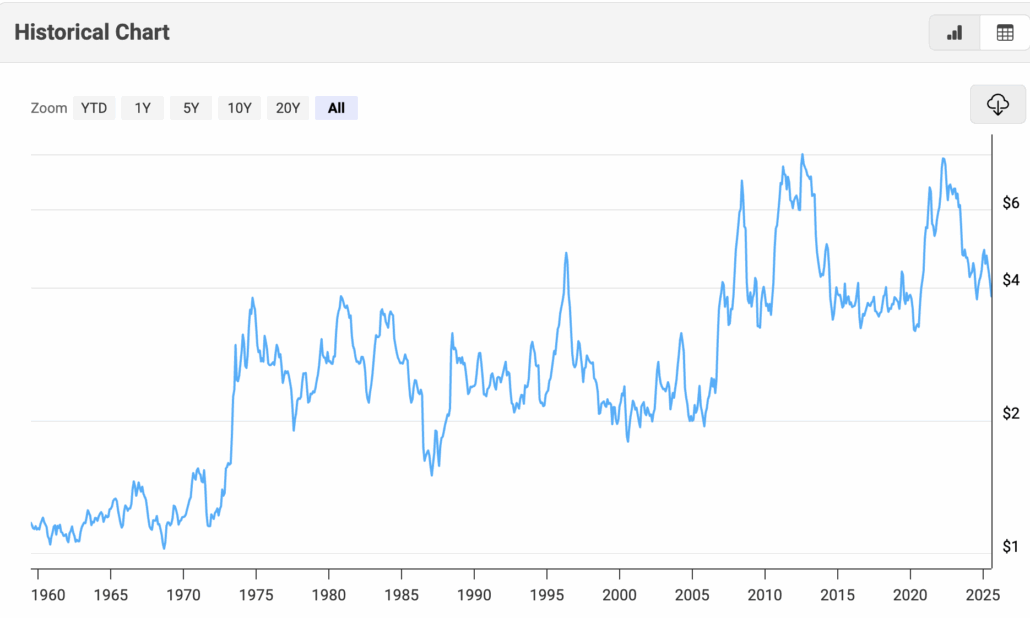
Below is a historical view of US dollar per bushel of corn.
Below is just a general data table from Iowa State showing the average cost of Crop Production.
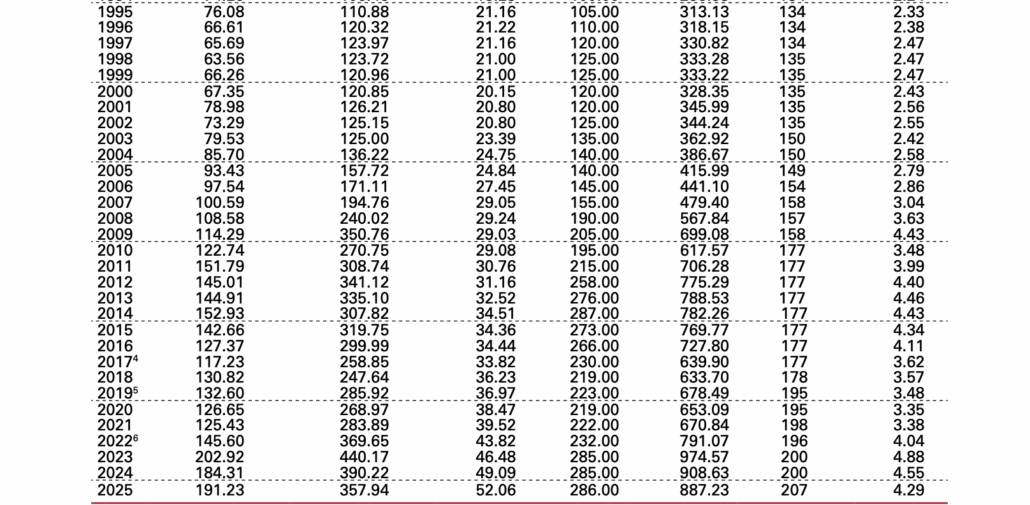
Focus on the number in the far right column. Obviously, we are taking big strokes here, but I assume we’ve all taken Econ 101 at one of the great Universities or community colleges. The point is, with weak prices, and bumper crops expected this year (which will drive prices down), and no winds of change blowing to indicate that anything might change over the next few years …
One is allowed to hope these economic conditions might bring a short vacation to the amount of …
- corn planted
- new land tilled up
- fertilizer spread
- chemicals sprayed
- drainage tile installed
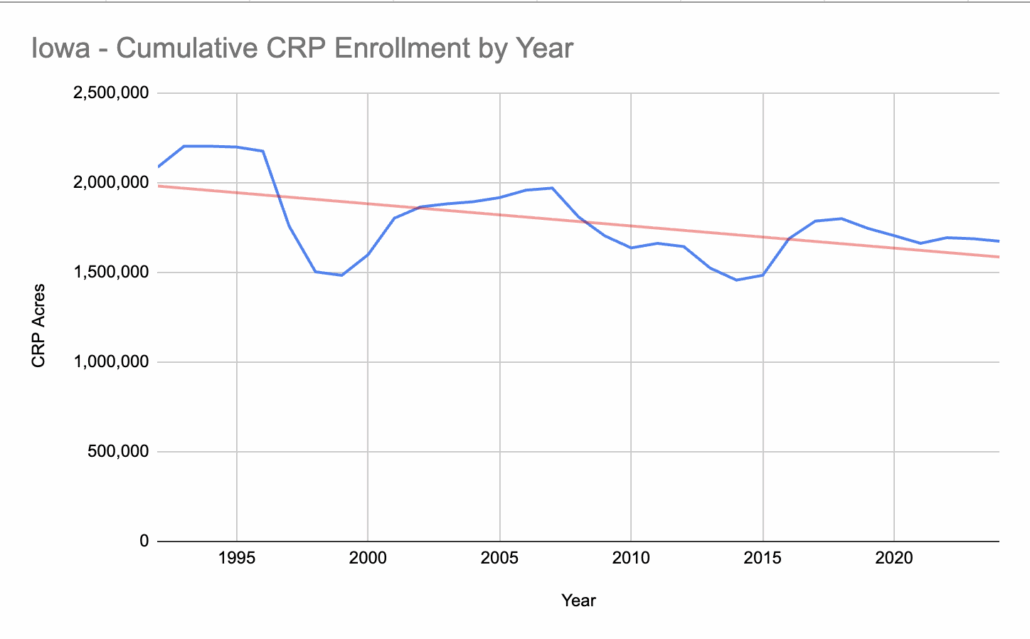
All of the above, which will have the pheasants cackling for joy and the fish breathing (gulping?) a sigh of relief. Look at the chart below of cumulative CRP-enrolled acres in Iowa over the last few decades. The red is the treadline.
We need that trendline to reverse a little.
The only real way that is going to happen is if fewer corn acres are planted. The only way less corn corn acres are going to be plowed up and planted is some sort of outside circumstance, like economics, that would drive a change, therefore, most likely increasing CRP, and reducing inputs that have become so much of a problem.
A word to the skeptics and “conservation practices” crowd.
Listen. I grew up in the area of long and wide fence rows where the landscape was dotted with old homesteads turned oak groves, rabbit and pheasant hunting down those twenty-foot-wide buffers between fields and creeks. Times have changed a little, have they not?
One would argue, in this culture, we are the zeinths of “environmentalism” and “conservationism,” and yet here we sit. Noticeably worse off than before, with dirty water, polluted land, and the treadlines going in the wrong direction. What we just need “one more conservation and education program that pays the farmer to do the right thing.“
Ah, yes, I’m sure that’s it, just one more program, just a few billion or million more towards this or that, and it will all turn around on the drop of a dime. I cannot believe people are still pushing this narrative as the way to “fix the problem” after decades of failure.
If your plan relies on paying farmers to do the right thing, then you have already lost. If your argument is based on the almighty dollar, then clearly, as history has shown, the corn dollar will scream harder and louder, and the CRP will decrease, and the tile lines will increase.
Let the bad times roll.
You might not agree with me, but I’m sticking to my guns. Let the bad times roll. You want fewer tile lines dumping nitrogen into your river? You want fewer pesticides being dumped on your land and running into the creek? You want to see CRP, field edges, buffer strips, and large fence lines come back into Vogue?
Then let the bad times roll; if John Deere suffers, the land will heal.
